
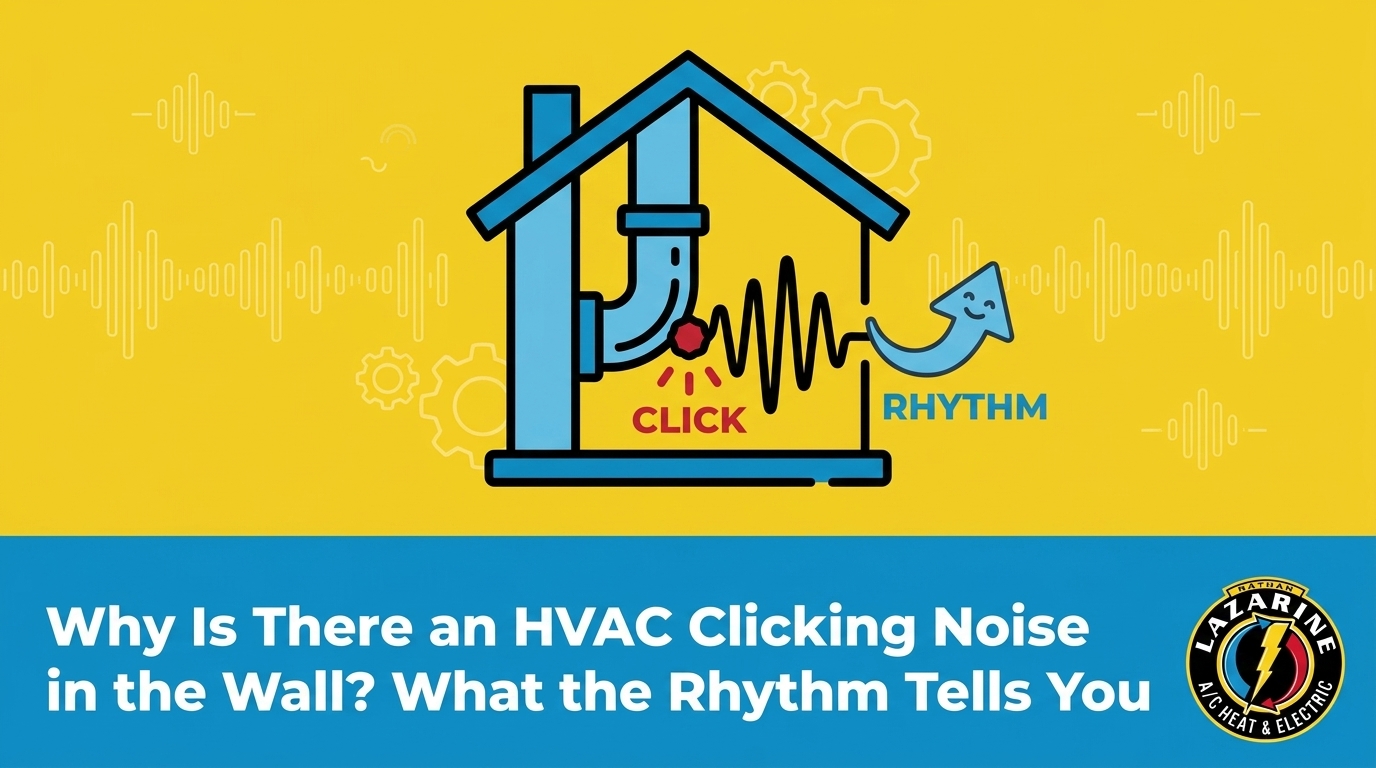
Why Is There an HVAC Clicking Noise in the Wall When the AC Turns On?
If you are tracing the source of rhythmic clicking noises inside your HVAC walls, you already know the frustration of a system that sounds busy but delivers zero cold air. You walk over to the thermostat, lower the temperature, and wait for the familiar rush of conditioned air. Instead, you hear a strange, repetitive tapping echoing through the drywall. Is your air conditioner actually broken, or is it just struggling to start?
Not all clicking sounds point to the exact same problem. The air conditioning system relies on a sequence of electrical relays, motors, and high-voltage components to move heat out of your home. When one of those components fails to engage, it often announces the failure audibly. The rhythm of that sound is your best diagnostic clue. A fast, continuous chatter means something entirely different than a slow, heavy knock or a single click followed by a buzz.
Dealing with these sudden noises is a highly common mid-summer emergency, especially for homeowners in Missouri City TX. When the heat index climbs, cooling systems work overtime, and the resulting strain pushes aging electrical parts to their breaking point. Because these sounds almost always indicate an electrical or mechanical failure, they require professional attention rather than a do-it-yourself fix.
For homeowners needing AC repair solutions, understanding what these rhythms mean is the very first step toward securing reliable AC repair in Missouri City and restoring comfort to your home.
Immediate Action: Why You Must Turn Off the Thermostat
Before you spend time trying to diagnose the exact cause of the sound, you need to take immediate action to protect your equipment. If your air conditioner is clicking loudly but failing to blow cold air, walk to your thermostat and switch the system to the “Off” position right away.
Allowing a struggling system to continuously click and attempt to start can cause severe secondary damage. When an electrical relay fails to close properly, or a motor fails to spin, the system continues drawing high amperage. This excessive electrical current generates intense heat. If left running, a minor electrical issue can quickly fry expensive control boards or permanently burn out the compressor.
Listening to the exact timing of the clicks (rapid vs. delayed) should only take a few seconds of your time. Once you identify the rhythm, shut the system down. Do not let it run in the background hoping it will eventually catch and start cooling.
The Danger of High-Voltage Components
It is critical to understand that the components causing these noises handle lethal amounts of electricity. Even when the thermostat is turned off, certain parts of the outdoor condenser and indoor air handler retain high voltage. Never open the service panels or attempt to bypass electrical relays yourself.
Follow this safe shutdown checklist:
- Switch the thermostat to OFF: Do not just raise the temperature; turn the system completely off so it stops calling for cooling.
- Turn the fan to AUTO: Ensure the fan setting is not switched to “ON,” which might keep the indoor blower running unnecessarily.
- Listen for silence: Confirm that the clicking noise in the wall has stopped.
- Call a professional: Reach out to a licensed technician to investigate the electrical failure safely.
| Sound Type | Likely Severity | Required Action |
|---|---|---|
| Soft click when thermostat turns on | Normal operation | None. Safe to leave on. |
| Rapid, continuous machine-gun clicking | Electrical emergency | Turn thermostat OFF immediately. |
| Single loud click followed by buzzing | Starting component failure | Turn thermostat OFF immediately. |
| Slow, heavy mechanical knocking | Motor or compressor failure | Turn thermostat OFF immediately. |

Rapid, Continuous Clicking: The Contactor Switch
If the sound echoing through your walls resembles a fast, continuous chattering, a machine gun, or rapid tapping, the most likely culprit is a failing contactor switch. This is one of the most common electrical failures we see, especially when August late-summer cooling fatigue sets in and systems have been running non-stop for months.
The contactor is a high-voltage relay switch located in the outdoor condenser unit. Think of it as a heavy-duty drawbridge for electricity. When your indoor thermostat calls for cold air, it sends a low-voltage signal to the contactor. An electromagnet inside the contactor pulls the “drawbridge” closed, allowing high-voltage electricity to flow into the compressor and the outdoor fan motor.
Why the Contactor Chatters
Over the course of a single summer, that contactor switch opens and closes thousands of times. Every time those metal contacts snap together, they create a tiny electrical arc. Over time, this arcing causes the metal surfaces to pit, burn, and become uneven.
When the contacts become too damaged, or the electromagnet begins to weaken, the switch struggles to hold itself closed. It rapidly bounces open and shut, creating that fast, continuous clicking noise. Because the copper refrigerant lines connect the outdoor unit to the indoor air handler, this loud chattering sound often travels straight down the lines and echoes loudly inside your walls.
One local homeowner experienced this exact issue when their system wasn’t properly cooling the upstairs. After hearing the rapid clicking, they knew something was wrong. A technician came out the same day, identified the electrical failure, and fixed the cooling issue so the upstairs returned to a comfortable temperature. Dealing with sudden electrical failures is stressful, which is why we back our fast emergency response with a 100% Satisfaction Guarantee to give you confidence that the repair will be done right.
A professional technician can quickly test a faulty contactor with a multimeter and replace it, restoring the vital electrical connection to your compressor safely.
A Single Click Followed by a Hum: The Capacitor
Another classic auditory symptom of an electrical failure is a distinct single click, followed immediately by a low electrical hum or buzz. After a few seconds of humming, you will usually hear another click, followed by total silence. If you hear this exact timing of the clicks (rapid vs. delayed), your system is likely suffering from a bad capacitor.
The run capacitor is a cylindrical component that acts like a massive energy reserve for your air conditioner. The compressor requires a massive jolt of electricity to start moving—often more power than your home’s standard electrical wiring can provide all at once. The capacitor stores up this energy and delivers a concentrated boost to get the heavy compressor motor spinning.
The Anatomy of a Capacitor Failure
Missouri City’s intense, humid Gulf Coast summers force HVAC units to run almost constantly. This relentless workload, combined with extreme outdoor temperatures, leads to swollen, degraded capacitors from heat exposure. When a capacitor loses its ability to hold a charge, it cannot deliver that necessary jolt of energy.
Here is exactly what happens during this sound sequence:
- The first click: The contactor switch closes, sending voltage to the compressor.
- The low hum: The compressor tries to start, but without the boost from the dead capacitor, the motor simply locks in place and hums as it draws massive amounts of locked-rotor amperage.
- The second click: The compressor rapidly overheats. A safety device called a thermal overload protector trips, shutting off power to save the compressor from melting down.
- The silence: The system waits to cool down before trying the doomed cycle all over again.
If this happens frequently, or if your system struggles to start even after repairs, it might be one of the signs you need AC replacement. A technician will inspect the capacitor for obvious visual signs of failure, such as a bulging top or leaking oily fluid, and use a specialized meter to measure its microfarad rating.
Slow, Rhythmic Clicking: A Struggling Compressor or Fan Motor
While rapid chattering points to relays and humming points to capacitors, a slower, heavier clicking or knocking rhythm usually indicates a severe mechanical failure. This sound is often accompanied by a rattling vibration that you can feel through the floorboards or walls.
When August late-summer cooling fatigue sets in, the physical moving parts of your system bear the brunt of the wear and tear. A slow, rhythmic clicking usually means a motor is failing to rotate properly, a fan blade has come loose and is striking its metal housing, or the compressor itself is locked up and struggling internally.
Differentiating Indoor vs. Outdoor Mechanical Sounds
The location of the heavy clicking helps pinpoint the failing mechanical part:
- Clicking inside the house: If the slow knocking is coming loudly from the indoor air handler or vents, you likely have a failing blower motor. The bearings inside the motor can wear out, causing the fan wheel to wobble and strike the casing with every rotation.
- Clicking outside the house: If the heavy rhythmic knocking originates at the outdoor condenser, it could be a failing condenser fan motor or a dying compressor. The compressor contains internal valves and pistons; when these break under extreme pressure, they create a loud mechanical clanking.
When temperatures climb over 100 degrees, a failing motor can cause indoor heat to spike rapidly. One customer’s house reached 91 degrees after their AC motor was shot. A technician arrived quickly, replaced the motor within an hour, and got the AC back up and running so the house could cool down.
If you hear heavy mechanical knocking, shut the system down immediately to prevent the motor from seizing completely. For a broader look at different noises, you can review our guide on a home AC making clicking sounds to understand other potential causes.
Frequently Asked Questions About AC Clicking Noises
Homeowners often have specific questions when their air conditioning system starts making unusual sounds. Here are direct answers to the most common concerns regarding clicking HVAC components in Missouri City TX.
Why is my AC clicking but not turning on?
A clicking sound without the system turning on usually indicates an electrical failure preventing power from reaching the compressor or fan. The thermostat is sending the signal for cold air, but a component down the line is failing to execute the command. This is most commonly caused by a bad run capacitor that cannot start the motor, or a failing contactor relay that cannot stay closed. Diagnosing the exact electrical fault requires a professional multimeter test to perform safely.
What does a bad AC contactor sound like?
A bad AC contactor sounds like rapid, continuous clicking or loud electrical chattering. This distinct noise occurs when the electromagnet inside the high-voltage switch struggles to hold the metal contacts closed against the flow of electricity. The switch rapidly bounces open and shut. This sound is often heard near the outdoor unit, but the vibration frequently echoes through the copper refrigerant lines directly into the walls of your home.
Is a clicking AC dangerous?
A clicking AC can be dangerous to your equipment if left running, as it involves high-voltage electrical components that are failing to operate correctly. Continuous clicking means the system is drawing electrical current but failing to start, which generates excessive heat. This heat can cause secondary damage, such as melting wires, frying control boards, or permanently burning out the compressor motor. Always turn the system off at the thermostat to mitigate this risk.
Should I turn off my AC if it’s clicking?
Yes, you should immediately switch the thermostat to the “Off” position if your AC is clicking loudly and failing to cool. Do not let the system continue to run in the background. You do not need to flip the main electrical breaker unless you smell burning plastic or see smoke. Once the thermostat is off, call a licensed HVAC technician to investigate the electrical components and restore function safely.
Can a thermostat cause a clicking noise in the wall?
Yes, a failing thermostat relay can click repeatedly as it tries to send a low-voltage signal to the main unit. However, thermostat clicks are usually much quieter and originate directly from the plastic wall unit itself. If the clicking is loud, heavy, or sounds like it is coming from deep inside the vents, the walls, or the outdoor unit, the problem is not the thermostat. It is a heavier electrical relay or motor failing further down the line.
Get Fast Relief for Your Clicking AC System
Understanding the rhythm of your system’s sounds helps you communicate the problem effectively, but professional repair remains the only safe solution. Dealing with August late-summer cooling fatigue is incredibly common, and most electrical relay or capacitor issues can be resolved quickly by a trained technician with the right parts on their truck.
Stop worrying about tracing the source of rhythmic clicking noises inside your HVAC walls and let a professional handle the diagnosis. Turn your thermostat off to protect your equipment, and reach out to schedule reliable AC repair in Missouri City. We will identify the exact electrical or mechanical failure and restore your home’s cooling safely and efficiently.