Navigating Ductwork and Panel Upgrades During Historic Missouri City AC Retrofits
Lazarine AC
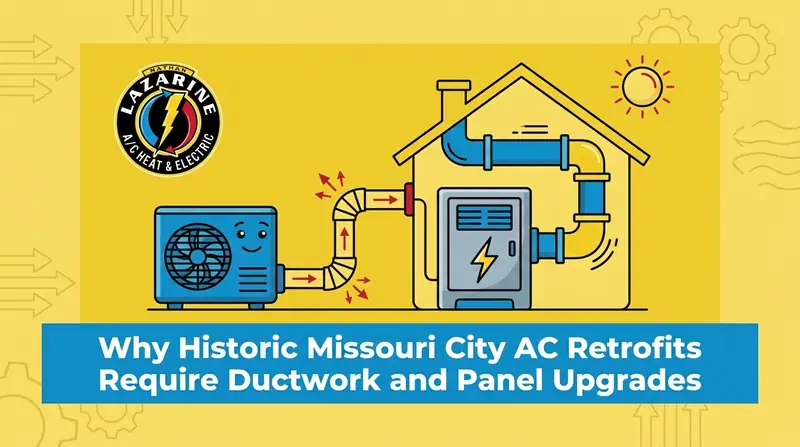
A simple equipment swap won't work for older properties upgrading to modern cooling. Expanding return air plenums and upgrading electrical panels is essential to safely support high-efficiency systems.
Confronting the Reality of Upgrading Older HVAC Systems
You finally decide to replace the struggling cooling system in your older property, only to discover that navigating ductwork and panel upgrades during historic Missouri City AC retrofits is a far more complex reality than a simple equipment swap. Many homeowners expect a straightforward process where technicians remove the old outdoor condenser, slide a new unit into place, and turn on the thermostat. However, when dealing with older architecture, this expectation quickly collides with the strict technical requirements of modern climate control technology.
If you are planning a new AC installation in Missouri City, understanding these hidden infrastructure requirements is the first step toward a successful upgrade. Older properties were originally built to accommodate lower-efficiency, single-stage air conditioners. These legacy systems operated with vastly different power draws and airflow requirements than today's advanced models. When you attempt to connect a highly efficient, variable-speed system to half-century-old wiring and undersized ventilation, the new equipment simply cannot function as designed.
Tackling these invasive infrastructure changes requires careful timing. The September pre-heating-season transition provides the ideal window for this level of whole-house modernization. During early fall, the intense summer heat begins to break, allowing your home to remain relatively comfortable while technicians open walls, expand plenums, and upgrade electrical panels over several days. Setting the expectation early that a proper retrofit is a comprehensive modernization project—rather than a quick afternoon swap—ensures your heritage property is fully prepared for decades of reliable, efficient cooling.
The 'Drop-In' Replacement Myth for Older Properties
The Problem with the Drop-In Approach
A "drop-in" replacement refers to the practice of installing a new air conditioner using the exact same electrical connections, copper refrigerant lines, and ductwork as the previous unit. While this might work for a home built five years ago, it is a dangerous myth for older architecture. Homeowners often assume that because their home already has central air, the "veins and arteries" of the house are perfectly fine. In reality, the infrastructure hidden behind the plaster of historic homes was never designed for the volumetric pressure of modern blowers.
The Cause of the Infrastructure Gap
The root of this problem lies in evolving construction and efficiency standards. Decades ago, original construction standards permitted smaller return ducts, lower-amperage breaker panels, and single-stage motors that pushed air at a single, forceful speed. Today, the Department of Energy (DOE) mandates strict efficiency minimums (such as SEER2 ratings), which require larger evaporator coils and variable-speed motors to achieve. Furthermore, the National Electrical Code (NEC) has heavily updated its safety guidelines regarding how much continuous load an electrical panel can safely handle.
The Solution: Comprehensive System Evaluation
Forcing a new, high-efficiency system onto old infrastructure is a recipe for disaster. It leads to premature system failure, constant tripped breakers, and severe safety hazards. The only viable solution is a comprehensive load calculation and infrastructure audit before any equipment is purchased. By measuring the exact cubic footage of the historic Missouri City home and evaluating the existing electrical service, licensed professionals can map out exactly which panels and ducts must be modernized to support the new technology safely.
Electrical Realities: Powering Today's Advanced Climate Technology
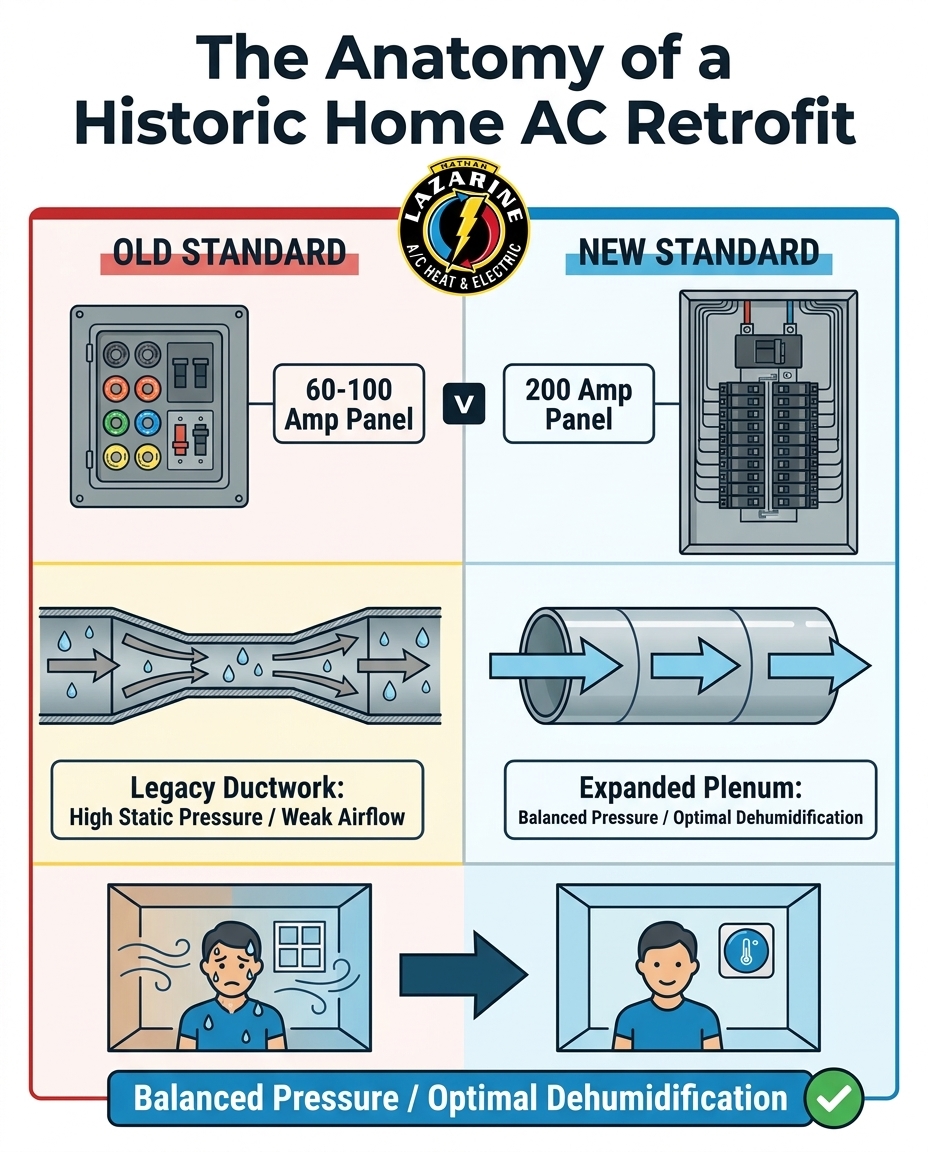
One of the most frequent surprises during a historic home retrofit is the mandatory electrical panel upgrade. Many older homes still operate on their original 60- to 100-amp electrical panels. While these panels were perfectly adequate for running a few incandescent lights, a refrigerator, and a low-efficiency air conditioner in the mid-twentieth century, they are entirely insufficient for the power demands of modern living combined with advanced climate control.
Modern high-efficiency AC units, particularly those featuring variable-speed compressors and high SEER2 ratings, require incredibly stable, dedicated power to operate their sensitive internal electronics. In most cases, safely powering these systems while simultaneously running modern appliances requires upgrading the home to a dedicated 200-amp service panel.
| Electrical Feature | Legacy Panels (60-100 Amp) | Modern Panels (200 Amp) |
|---|---|---|
| Total Capacity | Barely supports basic appliances and old HVAC. | Easily supports high-SEER2 HVAC, EV chargers, and modern tech. |
| Breaker Sensitivity | Prone to nuisance tripping under heavy startup loads. | Designed to handle the continuous load of variable-speed motors. |
| NEC Compliance | Often grandfathered in, but fails modern code for new heavy loads. | Fully compliant with current National Electrical Code safety standards. |
| Safety Risks | High risk of overheating, melted wires, and fire hazards. | Equipped with advanced grounding and arc-fault protection. |
Because of the severe safety implications, a licensed professional must perform a strict National Electrical Code (NEC) load calculation. This calculation determines the total electrical draw of the house and dictates the size of the required panel. Overloading an outdated panel with the high-amperage demands of a new compressor can lead to melted insulation, electrical fires, and the immediate voiding of your new equipment's warranty. Upgrading the panel is not an optional upsell; it is a critical safety requirement for the modernization of the property.
The Science of Airflow: Why Return Air Plenums Matter
Beyond the electrical panel, the most critical piece of infrastructure in your HVAC system is the return air plenum. The plenum is the large metal box located immediately before the air handler or furnace. It acts as the "lungs" of the HVAC system, pulling warm air from inside the house, filtering it, and feeding it into the cooling coil. If the system cannot breathe in enough air, it cannot push enough conditioned air back out into the living spaces.
The Hidden Dangers of High Static Pressure
When modern high-efficiency AC units are connected to undersized historic ducts, the immediate result is a drastic spike in static pressure. Static pressure is the resistance to airflow within the duct system. Think of it like trying to breathe heavily through a thin plastic straw—the harder you pull, the more the straw collapses, and the more your lungs strain. In an HVAC system, high static pressure forces the variable-speed blower motor to work at maximum capacity continuously just to pull air through a bottleneck.
This constant strain has severe consequences:
- Blower Motor Burnout: The ECM (Electronically Commutated Motor) overheats and fails years before its expected lifespan.
- Frozen Evaporator Coils: Without enough warm air passing over the indoor coil, the refrigerant drops below freezing, turning the indoor unit into a block of ice.
- Compressor Strain: Liquid refrigerant can travel backward into the outdoor compressor (a phenomenon called "slugging"), instantly destroying the most expensive component of the system.
To prevent this, the retrofit process almost always involves expanding the return air plenum. By fabricating a larger sheet metal transition and increasing the size of the return air drops, technicians ensure the system receives the exact volumetric airflow (measured in Cubic Feet per Minute, or CFM) required to operate efficiently and quietly.
Recognizing the Symptoms of Undersized Ductwork
Understanding the physics of static pressure is helpful, but homeowners usually recognize the problem through daily physical discomfort. When historic Missouri City homes are outfitted with improperly matched equipment, the house will quickly tell you that the ductwork is failing to support the system. If you are experiencing poor airflow from your vents, it is rarely a problem with the vents themselves—it is a symptom of a deeper infrastructure mismatch.
- Uneven Cooling and Hot Spots: When ductwork is too small to carry the required volume of air, the rooms closest to the indoor unit receive a blast of cold air, while rooms at the far end of the house remain uncomfortably warm. The system simply lacks the pressure balance to push conditioned air to the furthest branches of the ductwork.
- Loud Whistling or Roaring Vents: A properly sized HVAC system should be virtually silent. If you hear loud whistling, roaring, or rushing wind noises from your return grilles or supply registers, you are hearing high static pressure in action. The blower is forcing too much air through too small of an opening.
- Excessive Dust and Poor Air Quality: High static pressure creates negative pressure zones in the ductwork. This suction can pull dust, attic insulation, and crawlspace debris through tiny leaks in the old metal seams, blowing it directly into your living spaces.
- Frequent System Cycling: If the unit turns on for only three or four minutes, blasts air, and shuts off, the undersized ducts are causing the internal safety limits to trip, preventing the system from completing a full, healthy cooling cycle.
Linking these symptoms directly to the need for duct modification during a retrofit is crucial. If these issues exist with your current system, installing a new, more powerful unit will only magnify the symptoms unless the ductwork is expanded simultaneously.
Managing Extreme Humidity with Properly Sized Infrastructure
Missouri City's extreme summer heat and high humidity make proper dehumidification non-negotiable. In this regional climate, an air conditioner's job is not just to lower the temperature; it must actively pull gallons of moisture out of the indoor air every single day. Modern high-efficiency AC units are specifically engineered to excel at this by running longer, slower cooling cycles that give the indoor coil ample time to wring moisture out of the air.
However, this advanced dehumidification process is entirely dependent on properly sized ductwork. When a new system is connected to undersized historic ducts, the restriction causes the system to short-cycle. Short-cycling occurs when the unit turns on, rapidly cools the immediate area around the thermostat, and shuts off before it has had time to remove any meaningful humidity from the broader house. The air might feel cold, but it will feel clammy, heavy, and uncomfortable.
The impact of prolonged high indoor humidity on historic building materials is devastating. Heritage properties feature original hardwood floors, custom plasterwork, and vintage wood framing. When indoor humidity remains above 60% due to a short-cycling AC, these materials absorb the moisture. Hardwood floors buckle, plaster cracks, and hidden mold begins to degrade the structural integrity of the home. Expanding the return air plenum and ensuring the ductwork matches the equipment ensures the system can run its full, intended cycle, handling intense regional moisture loads and preserving the architectural integrity of the home.
Navigating the Scope of Work and Investment Options
Discovering that a simple equipment swap has evolved into a comprehensive infrastructure project can be daunting. Homeowners often experience sticker shock when the scope of work expands to include a new 200-amp electrical panel and custom sheet metal fabrication for expanded plenums. However, it is essential to frame these upgrades not as unexpected burdens, but as a necessary, long-term modernization investment that protects both the heritage property and the new equipment.
After a detailed inspection of an aging system, one local homeowner learned their existing unit required complete replacement and significant infrastructure adjustments. Rather than attempting a quick, unsafe patch, they were provided with comprehensive modernization options and had a new unit installed professionally, backed by continuous communication to ensure the home was cooling effectively and safely. Doing the job right the first time prevents catastrophic failures down the road.
Fortunately, exploring flexible financial solutions can ease the burden of unexpected infrastructure requirements. Utilizing tools like 0% Same as Cash Financing for 12 months allows homeowners to manage the expanded scope of panel and duct upgrades seamlessly, without compromising on safety or system efficiency. This ensures you can finance your AC unit and its necessary support systems responsibly. Additionally, generic federal energy rebates or tax credits may apply to qualifying high-efficiency installations, helping to offset the overall investment. Planning this comprehensive work during the September pre-heating-season transition ensures you have the time to review all financial options without the pressure of a mid-summer breakdown.
Frequently Asked Questions About Complex AC Installations
Why do I need a new electrical panel for my new AC?
Modern HVAC systems require highly stable, specific amperage to operate their advanced electronics and variable-speed motors safely. Older homes often feature 60- to 100-amp panels that simply cannot handle these new loads without overheating or tripping breakers. Upgrading to a dedicated 200-amp service panel ensures your electrical system meets current National Electrical Code (NEC) safety standards and protects your new investment from electrical damage.
How does an undersized return air plenum affect AC performance?
An undersized return air plenum acts like a bottleneck, severely restricting the amount of air the system can breathe in. This restriction drives up static pressure, forcing the blower motor to overwork continuously just to pull air through the narrow opening. Over time, this constant strain reduces efficiency, drives up utility bills, and significantly shortens the lifespan of the compressor and blower motor.
What causes weak air flow from vents after installing a new AC?
Weak airflow after a new installation usually means the new, powerful system is trying to push air through legacy ductwork that is too small for its volumetric output. This creates pressure bottlenecks throughout the house, preventing conditioned air from reaching the furthest rooms. The solution is typically expanding the return air plenum and modifying the trunk lines to balance the static pressure.
Do I need to replace all my ductwork when replacing my AC?
You do not always need to replace every single duct in the house, but critical components almost always require modification. The return air plenum and the primary supply trunk lines often require expansion to handle the modern volumetric needs of modern high-efficiency AC units. A licensed professional will perform a static pressure test to determine exactly which sections of the ductwork must be upgraded.
Can you put central air in a historic home without ruining the architecture?
Yes, you can absolutely install modern central air in a historic home without compromising its architectural charm. It requires careful planning, precise load calculations, and targeted infrastructure upgrades performed by experienced professionals. By creatively routing expanded plenums in basements, attics, or utility closets, technicians can deliver modern comfort while preserving the original aesthetics of the living spaces.
Securing Long-Term Comfort for Your Heritage Property
Proper infrastructure is the undeniable foundation of modern HVAC performance. You cannot achieve the quiet, efficient, and powerful cooling promised by today's advanced systems if they are suffocated by undersized historic ducts or starved for power by an outdated electrical panel. Navigating these upgrades is a vital part of preserving and modernizing your property for the future.
If you live in one of the beautiful historic Missouri City homes and are considering an upgrade, we strongly encourage you to seek a comprehensive evaluation of your home's electrical and ductwork capacity before purchasing equipment. Understanding your home's true infrastructure needs ensures you won't be caught off guard by hidden requirements. Backed by a 100% Satisfaction Guarantee, our team is ready to help you explore your AC replacement options and design a retrofit plan that brings safe, reliable, and powerful comfort to your heritage home.
Related Articles
The End-of-Season AC Replacement Dilemma: Limping Through September vs. Upgrading Now
A major late September AC breakdown forces a tough choice. Weigh the long-term value of a pre-heating season upgrade against the wasted sunk costs of a temporary patch.
Read Article
Diagnosing Sudden Airflow Drops in Single-Story Texas Ranch Homes
If a new filter didn't fix your weak vent pressure, the culprit could be in your attic. Extreme heat collapses older flex ductwork, requiring a professional inspection to restore airflow.
Read Article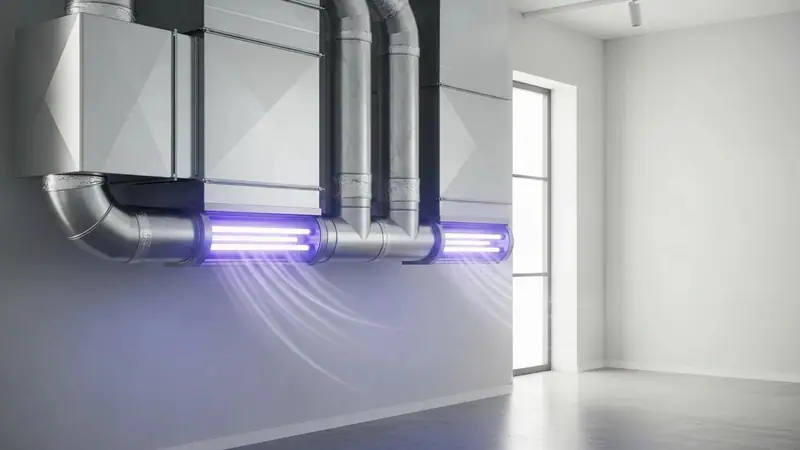
Enhance Your HVAC Efficiency with Germicidal UV Light
Boost HVAC efficiency with germicidal UV light and air purifiers. Improve air quality, reduce allergens, and create a healthier home environment today!
Read ArticleReady to Get Started?
Whether you need a repair, maintenance, or a new installation, our expert team is here to help.